You can't feel bone loss happening. But the drop in estrogen during perimenopause accelerates it dramatically, turning a structural asset into a hidden vulnerability.
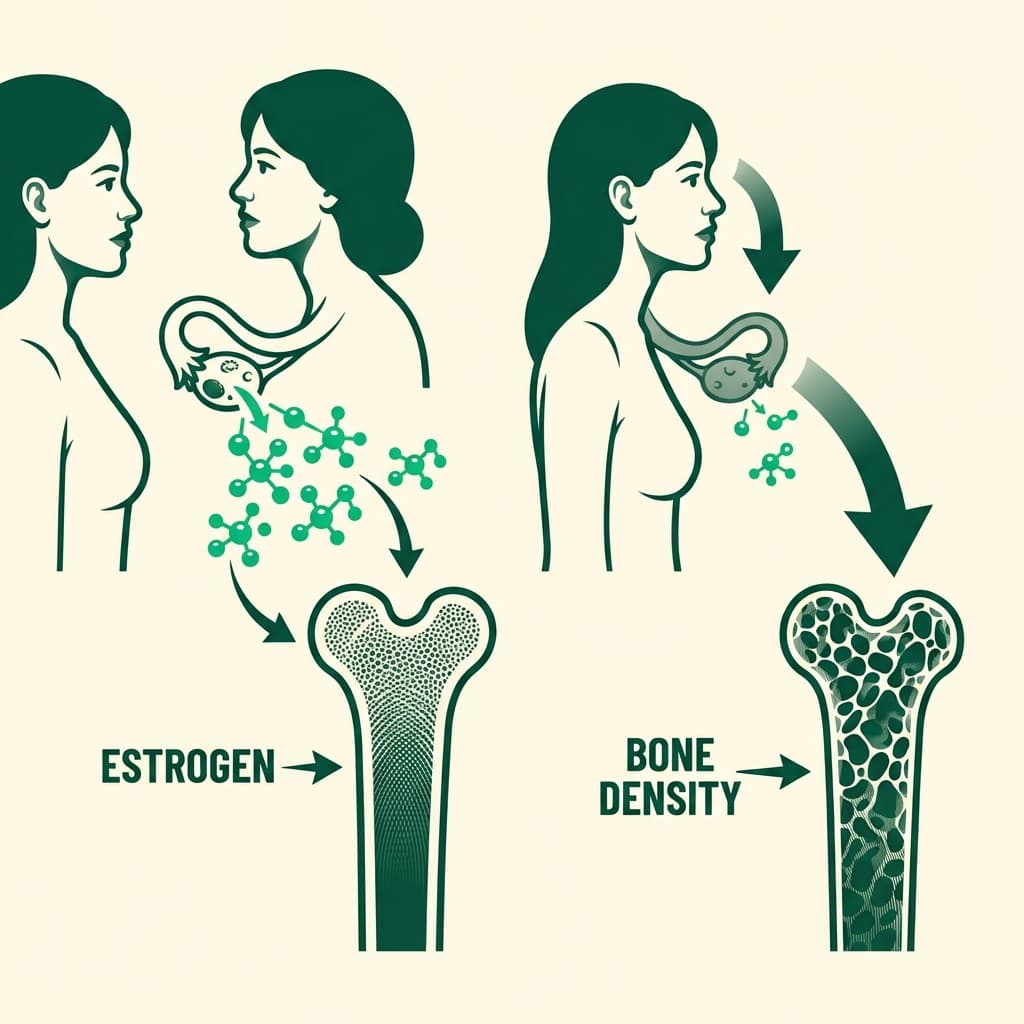
The Silent Threat
Most symptoms of perimenopause are impossible to ignore. You feel the hot flashes, the brain fog, and the sudden anxiety.
But one of the most critical shifts happens in complete silence: the loss of bone density.
You cannot feel your bones getting thinner. But the biological changes occurring during the menopausal transition are dismantling your structural foundation, setting the stage for osteoporosis.
The Estrogen Connection
Your bones are not static pillars of calcium. They are dynamic, living tissue that is constantly being broken down (by cells called osteoclasts) and rebuilt (by cells called osteoblasts).
Estrogen is the master regulator of this remodeling process. It keeps the destructive osteoclasts in check.
When estrogen levels plummet during perimenopause and menopause, the osteoclasts are unleashed. They begin breaking down bone tissue much faster than the osteoblasts can rebuild it.
The result? Accelerated bone loss. Women can lose up to 20% of their bone density in the five to seven years following menopause.
The Problem with the Standard Approach
The standard medical advice for bone health—"take a calcium supplement and go for a walk"—is fundamentally inadequate for a woman going through the menopausal transition.
- Calcium is not enough: While calcium is necessary, without the estrogen signal to direct it into the bone, it will not stop the osteoclasts from dismantling your skeleton.
- Walking is not enough: Bone, like muscle, responds to mechanical stress. Walking does not provide enough heavy loading to signal the osteoblasts to build new bone.
The Protocol for Structural Longevity
To protect your skeleton, you must send a stronger signal to your body.
- Hormone Replacement Therapy (HRT): Systemic estrogen therapy is the most effective way to halt the accelerated bone loss of menopause. It tells the osteoclasts to stop their excessive dismantling.
- Heavy Resistance Training: You must lift heavy things. Compressive forces on the spine and hips (like squats and deadlifts) signal the bones to increase density. If you are not lifting weights that challenge you, you are not protecting your bones.
- Nutrient Cofactors: Calcium needs Vitamin D3 and Vitamin K2 to be properly absorbed and directed into the bone matrix. Without K2, calcium can end up in your arteries instead of your bones.
Scientific References
- Riggs, B. L., Khosla, S., & Melton, L. J. (1998). "The role of estrogen in bone remodeling." Journal of Clinical Investigation.