You used to be driven. Now, you feel apathetic. It's not a character flaw—it's the Estrogen-Dopamine connection failing.
The Apathy Awakening
You wake up. You look at your to-do list. The list that used to energize you now fills you with a deep, hollow sense of apathy. The projects that once sparked joy feel like heavy stones.
You tell yourself you are just burnt out. You tell yourself you need a vacation. You tell yourself you are becoming lazy.
Stop telling yourself these lies.
AUDIENCE: Women 35+ This article is engineered for women navigating midlife who feel an inexplicable loss of drive, motivation, and joy, and incorrectly blame it on a personal failing.
What is "The Dopamine Drop"?
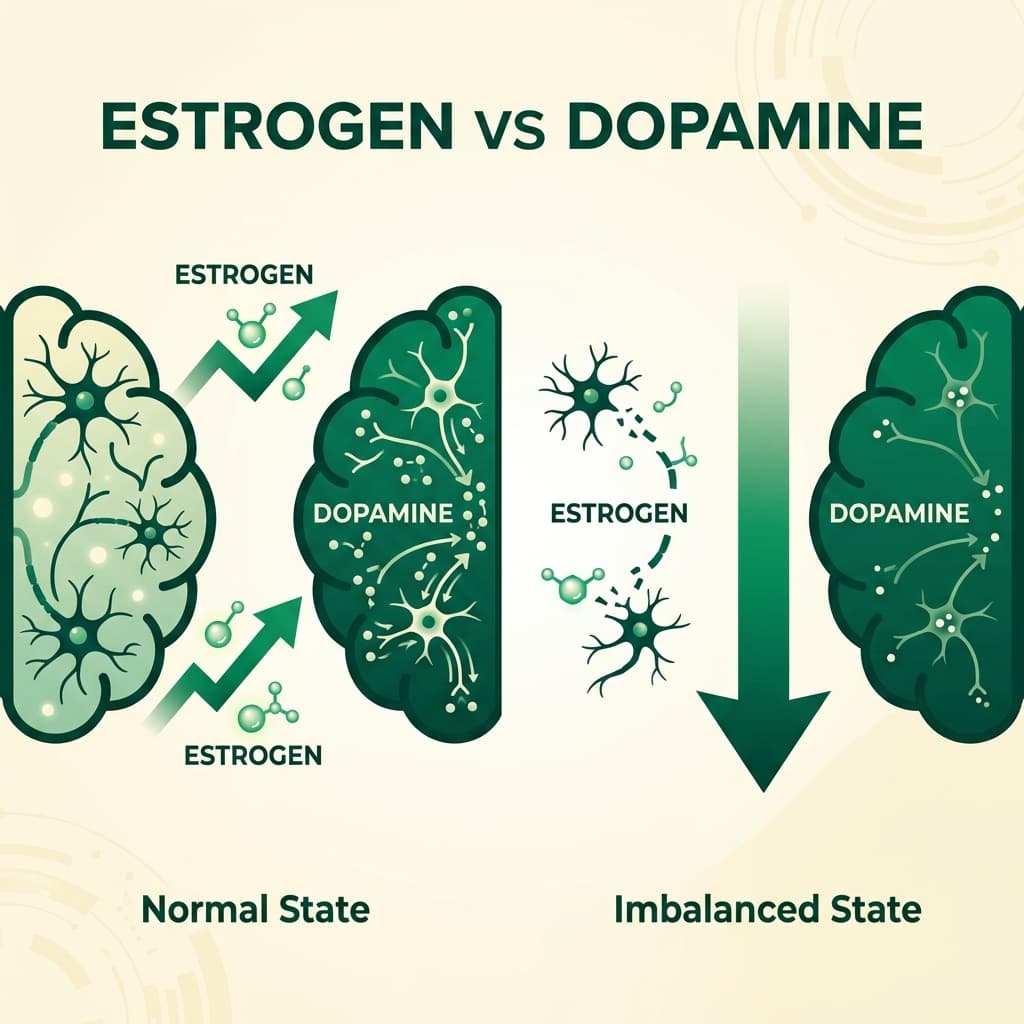
The Dopamine Drop is the neurochemical down-regulation of the brain's reward and motivation center caused by declining estrogen levels during perimenopause. Because estrogen acts as a primary modulator for dopamine synthesis and receptor sensitivity, its absence leads to profound apathy, loss of drive, and anhedonia (the inability to feel pleasure). This requires strategic nutritional and behavioral protocols to overcome.
The Mechanism: Estrogen's Role as the Spark Plug
To understand why you've lost your drive, you have to understand the intimately intertwined relationship between Estrogen and Dopamine.
Dopamine is not just the "pleasure" chemical. It is the molecule of motivation, drive, craving, and effort. It is the chemical that makes you want to do things.
Here is what happens when Estrogen is high (as it was in your 20s):
- Estrogen stimulates the production of the enzyme that makes Dopamine.
- Estrogen increases the number of Dopamine receptors in your brain.
- Estrogen prevents the breakdown of Dopamine, keeping it active in your synapses longer.
The Perimenopause Shift: As you enter your late 30s and 40s, Estrogen becomes erratic and eventually drops. Without its chief biological cheerleader, the Dopamine system falters. Your brain is literally producing less motivation, and the receptors are less sensitive to the motivation you do produce.
You are not burned out. Your biochemical spark plug has simply lost its charge.
The Difference Between Burnout and Dopamine Depletion
It is vital to distinguish between a psychological issue and a neurochemical one.
- Burnout: You care too much, work too hard, and hit a wall of exhaustion.
- Dopamine Depletion: You simply do not care. The reward for the effort does not register.
When women experience the Dopamine Drop, they often seek out highly stimulating behaviors to feel something. This manifests as doom-scrolling, an increase in wine consumption, or sugar cravings. These provide a cheap, fast dopamine hit that quickly crashes, leaving the baseline even lower.
The Protocol: Upregulating the Drive
You cannot simply "will" yourself out of a dopamine deficit. You must rebuild the chemistry.
1. The Fuel: L-Tyrosine and Protein Pacing
Dopamine is made from an amino acid called L-Tyrosine.
- The Action: You must provide the raw materials. Eat 30g of high-quality protein (beef, eggs, salmon) within 30 minutes of waking up.
- The Supplement: If the apathy is severe, consider supplementing with 500mg of L-Tyrosine on an empty stomach in the morning.
2. The Signal: Morning Sunlight Anchoring
Your dopamine system is intimately tied to your circadian rhythm.
- The Action: Within 15 minutes of waking, get outside and expose your eyes (no sunglasses) to natural sunlight for 10-15 minutes.
- The Mechanism: This triggers a massive spike of morning Cortisol and Dopamine, setting the "clock" for the entire day.
3. The Subtract: Eliminate Cheap Dopamine
To make your receptors more sensitive, you must stop bombarding them with cheap hits.
- The Action: Implement a strict "No Phone in the First Hour" rule upon waking. Reduce alcohol, which temporarily spikes dopamine but down-regulates receptors long-term.
4. The Catalyst: Zone 2 and Cold Exposure
- The Action: 45 minutes of Zone 2 cardio (where you can barely hold a conversation) or a 1-3 minute cold plunge.
- The Mechanism: Cold exposure has been shown to increase baseline dopamine levels by up to 250% for hours afterward.
Reclaiming the Fire
The loss of drive is a biological symptom, not a moral failing. By understanding the Estrogen-Dopamine connection, you can step out of the shame spiral and into the science of recovery.
You haven't lost your fire. You just need to rebuild the kindling.
Research Facts
- Fact 1: Estrogen acts as a powerful neuromodulator that enhances both the synthesis of dopamine and the density of dopamine receptors in the brain.
- Fact 2: The decline of estrogen during perimenopause directly correlates with reduced dopaminergic tone, leading to symptoms of apathy, anhedonia, and loss of motivation often misdiagnosed as clinical depression.
- Fact 3: Behavioral interventions like morning bright light exposure and cold-water immersion can naturally upregulate dopamine baseline levels, compensating for the hormonal deficit.
Scientific References
- Barth, C., et al. (2015). "Sex hormones affect neurotransmitters and shape the adult female brain during hormonal transition periods." Frontiers in Neuroscience.
- Jacobs, E., & D'Esposito, M. (2011). "Estrogen shapes dopamine-dependent cognitive processes: implications for women's health." The Journal of Neuroscience.
- Newhouse, P., & Dumas, J. (2015). "Estrogen-cholinergic interactions: Implications for cognitive aging." Hormones and Behavior.