Why sudden, unexplained shoulder pain in your 40s and 50s is often a direct result of dropping estrogen levels.
Frozen Shoulder: The Weirdest Menopause Symptom No One Talks About
You wake up one morning and notice a dull ache in your shoulder. A few weeks later, you can't reach behind your back to hook your bra. A month after that, you can barely lift your arm to wash your hair.
You haven't injured it. You haven't started playing tennis. It just happened.
Welcome to Adhesive Capsulitis, more commonly known as "Frozen Shoulder." It is one of the most painful, debilitating, and surprising symptoms of perimenopause, and almost no one tells women to look out for it.
The Estrogen-Collagen Connection
To understand why your shoulder is suddenly freezing up, you have to understand what estrogen does for your connective tissue.
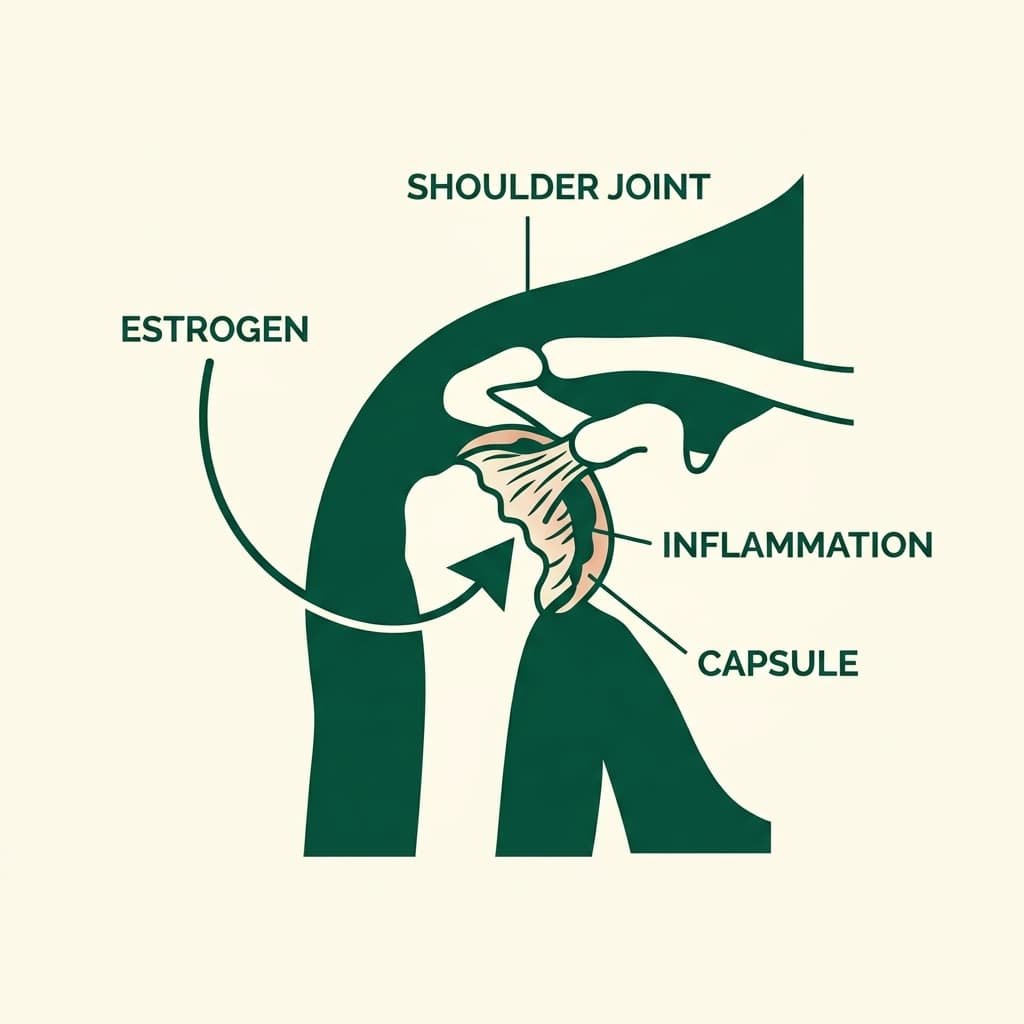
Estrogen is highly anti-inflammatory, and it is a critical regulator of collagen production and fibroblast activity (the cells that build your tendons and ligaments). The capsule surrounding your shoulder joint is made entirely of this estrogen-dependent connective tissue.
When estrogen levels begin to drop erratically during perimenopause:
- Collagen degrades: The tissue in the shoulder capsule becomes stiffer and less elastic.
- Inflammation spikes: Without estrogen's anti-inflammatory protection, micro-tears in the joint capsule trigger a massive inflammatory response.
The combination of stiffening tissue and localized inflammation causes the capsule to literally shrink and thicken around the shoulder joint, restricting movement and causing severe pain.
Why the Shoulder?
Women in perimenopause and menopause are disproportionately affected by frozen shoulder—in fact, women are up to four times more likely to get it than men, with the peak age of onset occurring precisely between 45 and 55.
While it can happen in other joints, the shoulder has the most complex and delicate capsule, making it highly susceptible to these hormonal and inflammatory shifts.
How to Thaw a Frozen Shoulder
Conventional medicine often treats this purely as an orthopedic issue (steroid injections, physical therapy). While physical therapy is essential to maintain range of motion, addressing the root hormonal cause can significantly speed up recovery.
- Systemic HRT (Hormone Replacement Therapy): Restoring systemic estrogen levels is often the fastest way to reduce the inflammation in the joint capsule and improve tissue elasticity.
- Anti-Inflammatory Nutrition: High doses of Omega-3 fatty acids, Curcumin, and a reduction in refined sugars can help bring down systemic inflammation.
- Gentle, Consistent Movement: Aggressive stretching can actually increase the inflammation. The goal is gentle, pendular movements to prevent the capsule from fully adhering.
Research Facts
- Fact 1: The incidence of adhesive capsulitis is highest in women between the ages of 45 and 55, directly correlating with the perimenopausal transition.
- Fact 2: Estrogen receptors have been identified in the connective tissues of the shoulder joint, confirming that the joint capsule is highly sensitive to hormonal fluctuations.
- Fact 3: Patients receiving Hormone Replacement Therapy (HRT) report a faster resolution of frozen shoulder symptoms compared to those receiving physical therapy alone.
Scientific References
- Ramírez, J., et al. (2014). "Adhesive capsulitis of the shoulder and menopause." Climacteric.
- Robinson, C. M., et al. (2012). "Frozen shoulder." The Journal of Bone & Joint Surgery.