It's not early dementia. It's your brain adapting to a new hormonal landscape. Here's what's really happening—and how to clear the fog.
The Moment You Realize Something's Wrong
You're in a meeting, and someone asks you a simple question. You know the answer—it's right there, on the tip of your tongue—but you can't access it. The word has vanished.
Or you walk into a room with purpose, only to stand there, completely blank, wondering what you came for.
Or you're reading the same paragraph for the third time because nothing is sticking.
You tell yourself it's stress. You tell yourself you're just tired. But deep down, a terrifying whisper starts: Is this early Alzheimer's?
Let me stop that spiral right now: You are not losing your mind. Your brain is recalibrating.
The Mechanism: Estrogen and Brain Energy
To understand brain fog, you have to understand the role of Estrogen in the brain.
Estrogen is not just a reproductive hormone. It is a neuroprotective agent. It:
- Enhances glucose metabolism in brain cells (your neurons need fuel).
- Protects neurons from oxidative stress.
- Supports the production of neurotransmitters like Serotonin and Dopamine.
- Maintains the integrity of the Hippocampus (memory center) and Frontal Cortex (executive function).
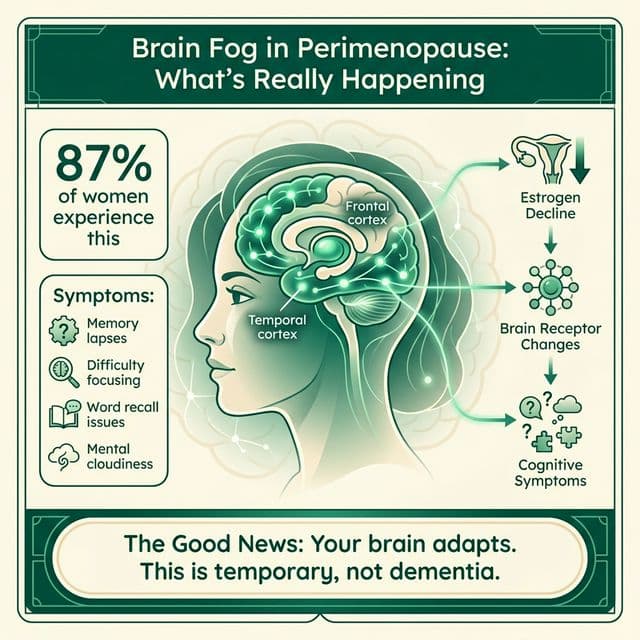
The Problem: In perimenopause, Estrogen levels fluctuate wildly and then decline. Your brain, which has been running on high-octane estrogen fuel for decades, suddenly experiences an energy crisis.
The Result: The brain enters a "hypometabolic" state. It's like trying to run a high-performance engine on low-grade fuel. The lights flicker. Processing slows. Memory retrieval lags.
This is not dementia. This is your brain adapting to a new normal.
The Symptoms: What Brain Fog Actually Feels Like
According to the 2025 Mayo Clinic/Flo study of over 17,000 women, 87% of women in perimenopause experience brain fog. Yet it remains one of the most under-recognized symptoms.
Common manifestations include:
- Memory Lapses: Forgetting names, appointments, or where you put your keys.
- Difficulty Focusing: Unable to concentrate on tasks that used to be easy.
- Word Recall Issues: The word is "right there," but you can't access it.
- Mental Cloudiness: Feeling like you're thinking through a fog or underwater.
- Slower Processing: Taking longer to make decisions or solve problems.
The Good News: It's Temporary
Here's what the research shows: Brain fog is a transition, not a destination.
Recent studies from 2025-2026 have identified structural changes in the brain during menopause:
- Temporary decreases in gray matter volume in the hippocampus and frontal cortex.
- Increased white matter hyperintensities (indicating reduced blood flow).
But—and this is critical—these changes are adaptive, not degenerative. The brain is pruning unnecessary connections and building new, more efficient pathways. You're not losing cognitive function; you're upgrading your operating system.
Think of it like this: Your brain is moving from "fast processing" (multitasking, people-pleasing, scanning for social cues) to "deep processing" (pattern recognition, strategic thinking, wisdom).
The Protocol: Clearing the Fog
You can't force your ovaries to produce more estrogen, but you can support your brain through the transition.
1. The Fuel Switch: MCT Oil
If your brain can't efficiently burn glucose anymore, give it an alternative fuel: Ketones.
- The Agent: MCT Oil (Medium-Chain Triglycerides), specifically C8 (Caprylic Acid).
- The Science: MCT oil bypasses normal digestion and goes straight to the liver, where it's converted into ketones. Ketones cross the blood-brain barrier and provide immediate energy to starving neurons—without requiring estrogen.
- Dose: Start with 1 teaspoon in your morning coffee. Work up to 1 tablespoon. You'll feel the mental clarity within 20-30 minutes.
2. The Neural Fertilizer: Lion's Mane Mushroom
- The Agent: Lion's Mane (Hericium erinaceus).
- The Science: Lion's Mane stimulates the production of Nerve Growth Factor (NGF), which promotes the growth and repair of neurons. It's like fertilizer for your brain.
- Dose: 1,000mg daily of a standardized extract.
3. The Hydration Fix
- The Reality: Most "brain fog" is actually dehydration. A 2% drop in hydration causes a 20% drop in cognitive function.
- The Action: Drink 16oz of water with electrolytes (sodium, potassium, magnesium) before your morning coffee.
- Why: Coffee is a diuretic. If you drink it on an empty, dehydrated stomach, you're compounding the fog.
4. The Protein Threshold
- The Rule: Your brain needs 30g of protein at breakfast to function optimally.
- Why: Protein provides the amino acids needed to make neurotransmitters (Dopamine, Serotonin). A carb-heavy breakfast (toast, cereal) spikes blood sugar and then crashes it, worsening brain fog.
- Visual: This is 3 eggs, a scoop of protein powder, or a palm-sized piece of salmon.
Summary
You are not broken. You are not "getting old." You are undergoing a neurological renovation.
Feed your brain fat (MCT oil), protect your neurons (Lion's Mane), hydrate properly, and give it the protein it needs. The fog will lift.
Research Facts
- Prevalence: 87% of women in perimenopause experience brain fog, yet it remains under-recognized in clinical practice (Mayo Clinic/Flo, 2025).
- Brain Changes: Perimenopause causes temporary decreases in gray matter volume in the hippocampus and frontal cortex, but these are adaptive, not degenerative (Mosconi et al., 2025).
- Estrogen's Role: Estrogen acts as a neuroprotective agent, enhancing glucose metabolism and protecting neurons from oxidative stress. Its decline creates a temporary energy crisis in the brain.
- Recovery: Brain fog typically improves as the brain adapts to new hormone levels, usually within 2-3 years post-menopause.
Scientific References
- Mosconi, L., et al. (2025). "Menopause and the Brain: Structural Changes and Adaptation." Nature Reviews Neurology.
- Mayo Clinic & Flo Health. (2025). "Global Study on Perimenopause Symptoms: Bridging the Knowledge Gap." Women's Health Research.
- Cunnane, S. C., et al. (2021). "Can Ketones Compensate for Deteriorating Brain Glucose Uptake During Aging?" Annals of the New York Academy of Sciences.