It's not your shampoo. It's your ratio of Testosterone to Estrogen. Here is how to block the shedding.
The Panic in the Shower Drain
There is a specific kind of terror that comes from washing your hair in your 40s. You look at your hands, and they are covered in strands. You look at the drain, and it is clogged. Again.
You tell yourself it's just stress. You buy expensive "thickening" shampoos. You take random Biotin gummies.
But six months later, you notice something else: Your part is wider. Your ponytail is thinner. And the hair around your temples is… fuzzy.
This is not stress. This is Androgenic Alopecia. You are not just losing hair; you are undergoing a masculinization of the follicle.
The Mechanism: The Androgen Shift
To understand hair loss, you have to understand the Estrogen/Testosterone Ratio.
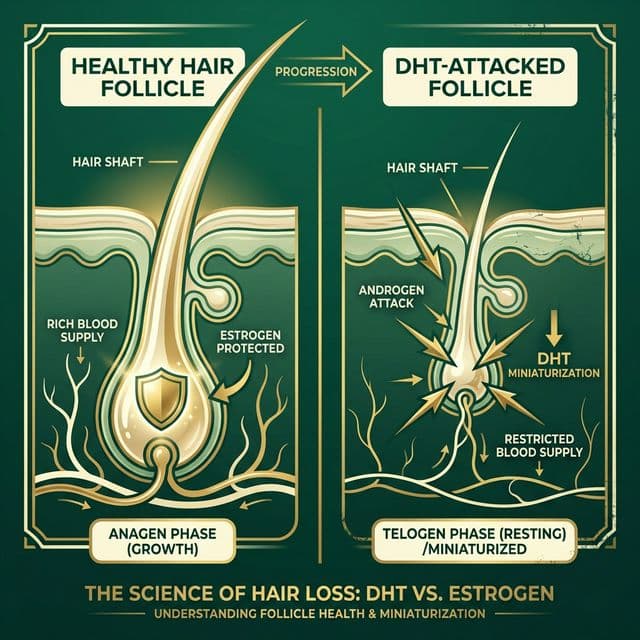
- Estrogen is a hair guardian. It keeps the hair follicle in the "Anagen" (growth) phase for years. It is why pregnant women have thick, lustrous hair.
- Testosterone is neutral, until it meets an enzyme called 5-Alpha Reductase.
When 5-Alpha Reductase meets Testosterone, it converts it into a super-potent androgen called DHT (Dihydrotestosterone).
The Problem: In your 20s, you had massive amounts of Estrogen to buffer this process. In perimenopause, Estrogen leaves the building. But your Testosterone often stays the same (relative dominance).
The Result: Without the Estrogen shield, DHT attacks your hair follicles. It physically shrinks them (Miniaturization). The follicle gets so small it can no longer hold a thick hair strand, so it produces a thin, wispy "peach fuzz" instead. Eventually, it closes up entirely.
The "Stress" Multiplier
To make matters worse, High Cortisol (Stress) pushes hair into the "Telogen" (resting) phase.
So you have a double attack:
- DHT is shrinking the follicle.
- Cortisol is telling the hair to fall out.
This is why "relaxing" isn't enough. You need to block the chemical attack.
The Protocol: Block & Nourish
We need to stop the conversion of Testosterone to DHT, and we need to extend the growth phase.
1. The DHT Blocker (Saw Palmetto)
- The Agent: Saw Palmetto Berry Extract.
- The Science: It acts like a natural Finasteride. It inhibits the 5-Alpha Reductase enzyme, preventing it from turning Testosterone into the follicle-killing DHT.
- Dose: 320mg daily (standardized extract).
2. The Pumpkin Seed Shield
- The Agent: Pumpkin Seed Oil.
- The Science: A 2014 study showed a 40% increase in hair count in men taking Pumpkin Seed Oil. It works via a similar pathway to Saw Palmetto but also lowers inflammation.
- Dose: 1000mg daily.
3. The Topical Caffeine
- The Myth: Expensive shampoos work. (They don't; they wash off).
- The Truth: Leave-in caffeine solutions work.
- The Science: Caffeine applied topically penetrates the follicle and counter-acts the suppression of DHT. It stimulates the hair shaft to grow longer.
- Action: Look for a scalp serum with caffeine and leave it on overnight.
4. The Ferritin Check
- The Bloodwork: You need to check your Ferritin (Iron storage).
- The Rule: If your Ferritin is under 70 ng/mL, your hair will not grow back, no matter what supplements you take. Your body considers hair "non-essential" and will divert iron to your red blood cells instead.
Summary
You are not "going bald." You are experiencing a hormonal ratio shift. Protect the follicle from DHT, check your iron, and the ponytail will return.
Research Facts
- DHT Sensitivity: 40% of women experience some degree of androgenic alopecia (FPHL) after menopause due to the relative increase in androgen activity.
- Iron Threshold: Dermatologists consistently cite a Ferritin level of >70 ng/mL as required for hair regrowth; average range (20-50) is often "normal" but insufficient for hair.
- Follicle Miniaturization: The primary mechanism of hormonal hair loss is not shedding, but the progressive shrinking of the hair shaft diameter by DHT.
Scientific References
- Cho, Y. H., et al. (2014). Effect of Pumpkin Seed Oil on Hair Growth in Men with Androgenetic Alopecia: A Randomized, Double-Blind, Placebo-Controlled Trial. Evidence-Based Complementary and Alternative Medicine.
- Ramos, P. M., & Miot, H. A. (2015). Female Pattern Hair Loss: a clinical and pathophysiological review. Anais Brasileiros de Dermatologia.
- Rushton, D. H. (2002). Nutritional factors and hair loss. Clinical and Experimental Dermatology.