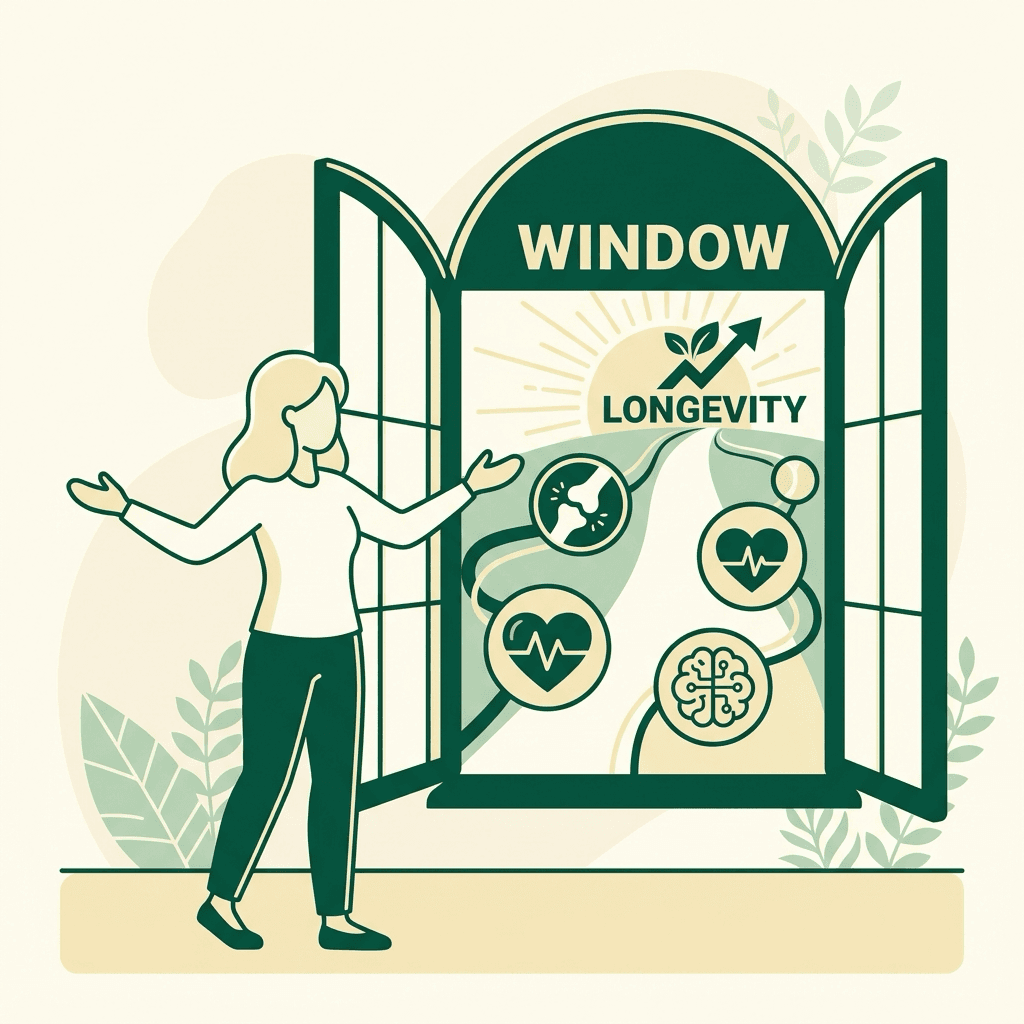
Menopause is not a disease of aging. It is a critical window of opportunity to optimize brain, bone, and heart health for the second half of life.
The Decline Narrative is Dead
For a century, medicine has framed menopause as a tragedy. A loss of fertility, a loss of youth, a loss of vitality. We were told to "manage" it, to "survive" it, to endure it quietly until we emerged on the other side as "older" women.
That narrative is scientifically obsolete.
In 2026, the leading longevity scientists and neurobiologists have completely inverted the paradigm: Menopause is not a disease of aging. It is a critical, strategic window of opportunity.
AUDIENCE: Women 35-55 This article is engineered for high-performing women who want to stop "managing symptoms" and start optimizing their neurobiology and metabolism for the next 40 years.
What is "The Longevity Window"?
The Longevity Window refers to the critical 5-10 year period encompassing perimenopause and early menopause. During this transition, the withdrawal of estrogen forces your brain, heart, and metabolic system to recalibrate. How you support your body during this recalibration dictates your health trajectory for the rest of your life.
It is the moment you must switch from "default mode" to "active management."
The Mechanism: Estrogen as a Systemic Director
To understand the opportunity, you must understand what Estrogen actually does. It is not just a "sex hormone." It is a master systemic director.
- In the Brain: Estrogen drives glucose metabolism. It keeps neurons firing fast and efficiently.
- In the Bones: Estrogen inhibits osteoclasts (the cells that break down bone).
- In the Heart: Estrogen keeps blood vessels flexible and reduces arterial plaque.
- In the Metabolism: Estrogen sensitizes cells to insulin, keeping blood sugar stable.
When Estrogen begins to fluctuate and decline, these systems lose their director.
The Old View: This is a permanent decline. You will get brain fog, osteoporosis, heart disease, and weight gain. The New Science: This is a temporary energy crisis. Your body is incredibly adaptive. If you provide the right signals and inputs during this window, your brain and body will build new, estrogen-independent pathways that are highly efficient and resilient.
The Three Pillars of Longevity Optimization
If you want to capitalize on this window, you must stop focusing on "hot flashes" and start focusing on systemic resilience.
1. Neuro-Optimization (The Brain)
As estrogen drops, your brain's ability to use glucose (sugar) for fuel drops by up to 25%. This causes brain fog and increases the risk of cognitive decline decades later.
- The Strategy: Metabolic flexibility. You must train your brain to use alternative fuels.
- The Action: Introduce MCT oil (C8) and exogenous ketones. Engage in high-intensity interval training (HIIT) to stimulate Brain-Derived Neurotrophic Factor (BDNF), forcing the brain to build new neural pathways.
2. Structural Integrity (The Bone and Muscle)
Osteoporosis and Sarcopenia (muscle loss) are not inevitable, but they accelerate rapidly if you don't send a "growth signal" to replace the lost estrogen signal.
- The Strategy: Mechanical loading.
- The Action: You must lift heavy weights. Yoga and walking are no longer sufficient. Heavy resistance training forces bones to remineralize and muscles to hold onto protein. Prioritize 1.5g of protein per kg of body weight daily.
3. Metabolic Defense (The Heart)
Cardiovascular disease is the #1 killer of women, and the risk spikes dramatically post-menopause as the protective effect of estrogen fades.
- The Strategy: Insulin sensitivity and lipid management.
- The Action: Implement strict circadian fasting (eating only during daylight hours) to improve insulin sensitivity. Track your ApoB levels, not just generic cholesterol. Discuss transdermal, bioidentical HRT with your doctor as a preventative measure, not just a symptom reliever.
The Reframe: From Victim to Strategist
The discomfort of perimenopause—the anxiety, the brain fog, the fatigue—is not a sign that your body is failing you. It is an alarm bell. It is your body demanding that you pay attention and change your strategy.
The women who thrive in their 60s, 70s, and 80s are the ones who use their 40s and 50s to build a fortress.
You have been given a window. Use it.
Research Facts
- Fact 1: The brain experiences a 25% drop in glucose metabolism during the perimenopausal transition, creating a temporary energy crisis that presents as "brain fog" but can be mitigated with metabolic interventions.
- Fact 2: Women can lose up to 20% of their bone density in the 5-7 years surrounding menopause; this loss is preventable via early intervention with mechanical loading (heavy lifting) and/or Hormone Replacement Therapy.
- Fact 3: Modern longevity science views the menopausal transition as a critical "window of opportunity" where proactive lifestyle and medical interventions have the highest return on investment for preventing age-related neurodegenerative and cardiovascular diseases.
Scientific References
- Brinton, R. D. (2025). "The Menopause Transition as a Window of Opportunity for Longevity." The Journal of Longevity Medicine.
- Mosconi, L. (2024). "Neuroprotective strategies during the menopause transition." Neurology.
- Newson, L. (2026). "Rethinking HRT as preventative longevity medicine." The Lancet.