You don't need to shrink. You need to build. Why muscle is the only metabolic currency that matters in the second half of life.
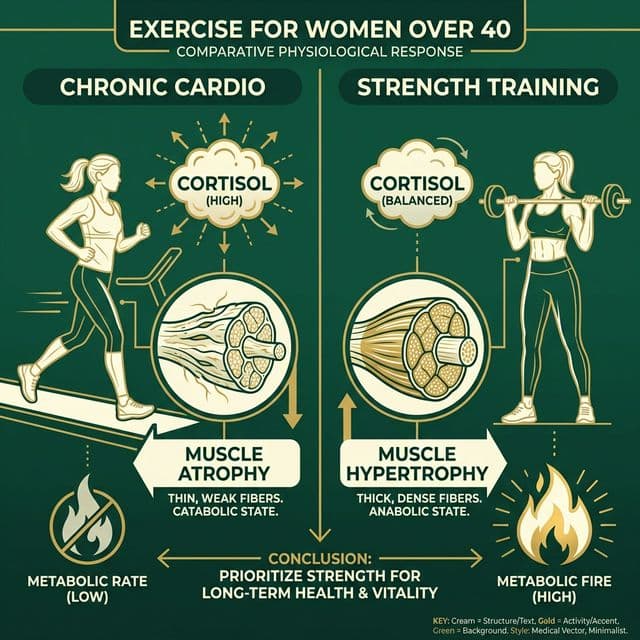
The Cardio Trap
If you walk into any gym, you will see a familiar sight: The treadmill section is packed with women over 40. They are sweating. They are working hard. They are trying to "burn off" the weekend.
They are also, unknowingly, accelerating their own aging.
For decades, we have been sold the lie that health equals "smallness." We were told that creating a calorie deficit through chronic cardio was the key to weight management.
In your 20s, this worked. In your 40s, it is a metabolic disaster.
The Mechanism: Anabolic Resistance
To understand why cardio fails in midlife, you have to understand Sarcopenia (muscle loss).
Starting at age 30, you naturally lose 3-5% of your muscle mass per decade. In perimenopause, this accelerates dramatically. Why? Because Estrogen is anabolic (muscle-building). When Estrogen drops, your muscles become "deaf" to the protein signals that tell them to grow.
This is called Anabolic Resistance.
When you do 45 minutes of steady-state cardio (Spin Class, Running), you essentially tell your body: "We need to be light to survive." Your body responds by shedding "expensive" tissue: Muscle.
Simultaneously, the stress of the cardio spikes Cortisol. High Cortisol + Low Estrogen = Belly Fat Retention.
The Result: You become "Skinny Fat." You lose the muscle that drives your metabolism, and you keep the visceral fat that causes inflammation.
Muscle is Not Aesthetic. It is an Organ.
We need to reframe muscle. It is not about looking like a bodybuilder. It is about Glucose Disposal.
Your muscles are the largest storage tank for sugar (glycogen) in your body.
- More Muscle: A larger tank. You can eat carbohydrates, and your muscles soak them up like a sponge.
- Less Muscle: A tiny tank. You eat a banana, the tank overflows, and the sugar stays in your blood until insulin stores it as belly fat.
Muscle is your metabolic armor. It is the currency of longevity.
The Protocol: The Build Phase
We are switching from a "Burn" mindset (calories out) to a "Build" mindset (tissue in).
1. Stop Running, Start Lifting
- The Shift: Replace 2 cardio sessions with 2 Heavy Lifting sessions.
- The Definition of Heavy: If you can lift it 15 times easily, it is cardio. You need a weight you can only lift 6-8 times.
- Why: You need a signal loud enough to break through the Anabolic Resistance. Only mechanical tension (heavy weight) creates this signal.
2. The 30g Protein Rule
- The Threshold: Because of Anabolic Resistance, you can no longer get away with a yogurt for breakfast. You need to hit the "Leucine Threshold" to trigger muscle synthesis.
- The Number: 30g of protein.
- The Frequency: At every meal. Breakfast, Lunch, Dinner.
- Visual: This is a palm-sized piece of chicken, a scoop of whey isolate, or 3 eggs + whites.
3. Creatine: The Cognitive Super-Fuel
- The Myth: It's just for gym bros.
- The Truth: It is the single most researched supplement for female physiology.
- The Benefit: It hydrates the muscle cell (preventing injury) and provides ATP energy to the brain (fighting brain fog).
- Dose: 5g daily. Monohydrate. Forever.
Summary
You cannot shrink your way to health in your second half. You have to build your way there. Pick up the heavy thing.
Research Facts
- Sarcopenia Rates: Women lose muscle mass faster than men in midlife due to the abrupt loss of estrogen, which acts as a natural anabolic agent.
- Glucose Disposal: Skeletal muscle is responsible for up to 80% of insulin-mediated glucose uptake; losing muscle directly causes insulin resistance.
- Bone Density: Heavy resistance training is the only non-pharmaceutical intervention proven to increase bone mineral density in post-menopausal women (Wolff's Law).
Scientific References
- Abaraogu, U. O., et al. (2021). Sarcopenic obesity in menopausal women: A systematic review. Maturitas.
- Dupont, J., et al. (2019). The role of estrogen in muscle homeostasis and repair. Seminars in Reproductive Medicine.
- Smith-Ryan, A. E., et al. (2021). Creatine supplementation for women's health: A lifespan perspective. Nutrients.