You aren't necessarily depressed. You are neurologically inflamed. How to lift the 'Grey Filter' without numbing yourself.
It isn't sadness. It is flatness.
You wake up, and the world looks grey. You aren't crying. You aren't devastated. You just don't... care. The hobbies that used to light you up? Boring. Your favorite hobby is now "staring at the wall". The music you used to love? Noise.
This state is called Anhedonia (the inability to feel pleasure). And in perimenopause, it is often misdiagnosed as Clinical Depression.
Doctors hand out SSRIs like candy at a parade. And for many women, these drugs are lifesaving. But for others, they numb the lows and the highs, leaving you feeling like a zombie.
There is another way. A botanical way.
Part 1: The Chemistry of "Meh"
Why does perimenopause feel so flat?
It is because your "Happy Hormones" (Serotonin and Dopamine) do not essentially exist in a vacuum. They depend on Estrogen to be produced.
- Serotonin (The 'It's All Good' Molecule): Estrogen stimulates the enzyme Tryptophan Hydroxylase, which makes Serotonin. When Estrogen drops, Serotonin production drops.
- Dopamine (The 'Let's Do This' Molecule): Estrogen protects your Dopamine neurons from dying. When Estrogen leaves, Dopamine fades.
So, you aren't "depressed" in the traditional psychological sense. You are suffering from a hormonally mediated neurotransmitter deficit.
Part 2: The Saffron Solution (Ancient Tech)
Enter Crocus sativus—the Saffron crocus.
For 3,000 years, Persian medicine used Saffron tea to treat "heavy heart." Today, modern science has caught up to confirm why it worked.
Saffron contains two potent bio-active compounds: Crocin and Safranal. These compounds work almost exactly like an SSRI (Selective Serotonin Reuptake Inhibitor). They block the reuptake of Dopamine and Serotonin in the brain, keeping those molecules active in your synapses for longer.
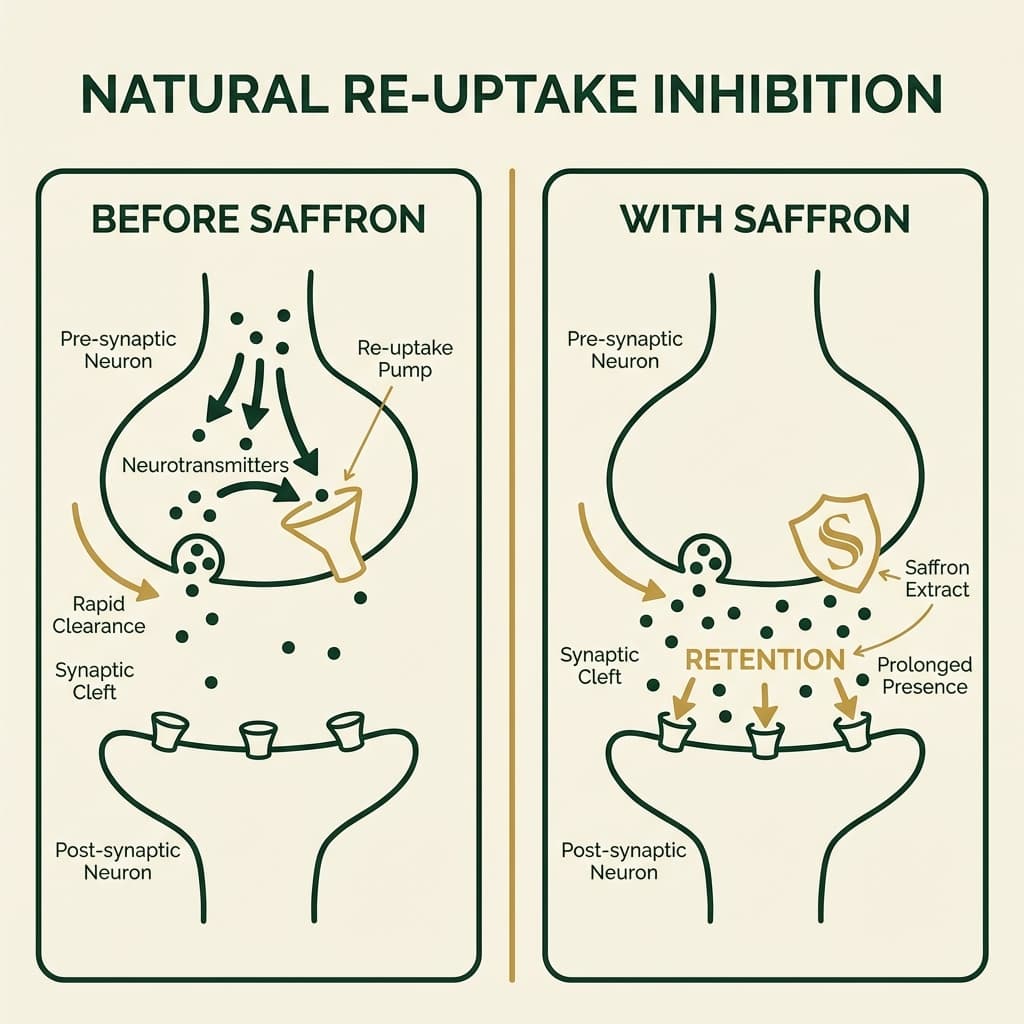
The Result: You get more "signal" from the limited Serotonin you have.
Part 3: The Clinical Showdown
In a landmark 2004 study published in BMC Complementary Medicine, researchers pit Saffron directly against Fluoxetine (Prozac).
- Group A: Took 20mg Prozac daily.
- Group B: Took 30mg Saffron extract daily.
The Result: After 6 weeks, the remission rates were statistically identical. Both groups felt significantly better. The Difference: The Saffron group reported zero sexual dysfunction. The Prozac group reported significant loss of libido and delayed orgasm.
Part 4: The Protocol (Reclaiming Joy)
If you feel the "Grey Filter" descending, here is how to lift it naturally.
Step 1: The Saffron Supplement
You cannot just eat paella. Culinary saffron is not potent enough. You need a standardized extract.
- Look for: A patented extract like Affron® or Saffr’Activ®. These ensure you are getting the active Crocin content.
- Dosage: 15mg twice daily (Total 30mg).
- Timing: One with breakfast, one with lunch. (It is stimulating, so avoid taking it before bed).
Step 2: The Cold Plunge (Dopamine Spike)
We need to jumpstart your Dopamine system.
- The Action: End your morning shower with 30-60 seconds of purely cold water.
- The Science: Sudden cold exposure causes a 250% increase in baseline Dopamine that lasts for hours. It is painful for 30 seconds, but the anti-depressant effect lasts all day.
Step 3: Polyvagal "Glimmers"
Your nervous system is currently wired to scan for "Triggers" (danger). We need to retrain it to scan for "Glimmers" (safety/joy).
- The Practice: Set an alarm for 3 times a day. When it goes off, stop and find one tiny thing that is beautiful. A slant of light. The smell of coffee. The texture of your sweater.
- The Why: This physically strengthens the Ventral Vagal pathways, making it easier for your brain to access joy states in the future.
Summary
You do not have to choose between being miserable and being numb. Nature has provided a toolkit to keep the lights on in your brain, even as the estrogen dims.
Clinical References
- Akhondzadeh, S., et al. (2004). Comparison of Crocus sativus L. and imipramine in the treatment of mild to moderate depression. BMC Complementary and Alternative Medicine.
- Hausenblas, H. A., et al. (2013). Saffron (Crocus sativus L.) and major depressive disorder: a meta-analysis of randomized clinical trials. Journal of Integrative Medicine.
- Sramek, P., et al. (2000). Human physiological responses to immersion into water of different temperatures. European Journal of Applied Physiology.