Stop running away from your cortisol. Start building the armor that protects your brain.
The Sarcopenia Trap: Why Cardio is Aging You Faster
AUDIENCE: Women 40+ This article is for women who have spent decades believing that "running" is the only way to manage weight, only to find themselves exhausted, injured, and softer in the middle.
What is "The Sarcopenia Trap"?
The Sarcopenia Trap is a biological mismatch that occurs in midlife. As estrogen drops, muscle mass naturally degrades (sarcopenia). Attempting to fix weight gain with excessive cardio spikes cortisol, which further catabolizes (eats) muscle tissue. The result is a slower metabolism and increased visceral fat, despite high effort.
I. The Hook: The Hamster Wheel
You are doing everything right. You are logging the miles. You are training for the half-marathon. You are sweating.
But when you look in the mirror, the definition isn't there. In fact, you feel... softer. And tired. Bone tired.
You have been told your whole life: To shrink, you must run. But you are no longer trying to shrink. You are entering a phase of life where you are disappearing—biologically speaking. Your bones are thinning. Your muscles are withering.
Running to "get smaller" in perimenopause is like chipping away at a statue that is already crumbling. It is time to stop shrinking. It is time to start building armor.
II. The Mechanism: Cortisol vs. Muscle
Why does the 5-mile run that kept you lean at 25 make you fat at 45?
The answer lies in the Cortisol-Insulin Loop.
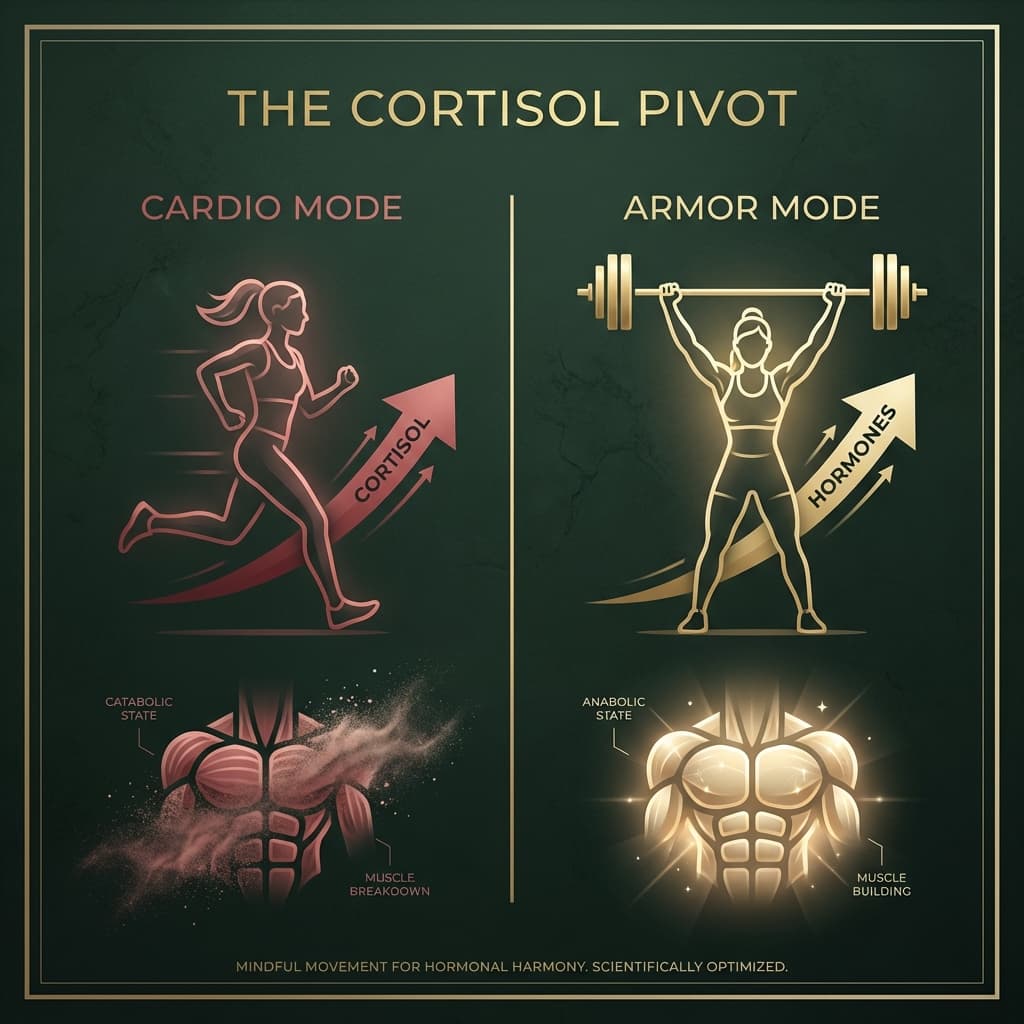
- The Stress Signal: Prolonged steady-state cardio (chronic running) is perceived by the aging body as a "Famine/Flight" signal.
- The Cortisol Spike: To fuel this flight, your body releases Cortisol.
- The Cannibalization: In the absence of estrogen (which protects muscle), high cortisol breaks down muscle tissue to create quick glucose.
- The Replacement: Because you are stressed, your body stores the next meal not as muscle glycogen, but as Visceral Fat (safety storage).
THE CARDIO TRAP Run More → Courtisol Spike → Burn Muscle → Lower Metabolism → Gain Fat → Run More.
It is a death spiral for your metabolic rate.
III. The Shift: Muscle is the Organ of Longevity
We need to reframe what muscle is. Muscle is not "bulk." Muscle is not "vanity."
Muscle is an endocrine organ. It secretes myokines—anti-inflammatory molecules that talk to your brain, your bones, and your immune system.
- Muscle is your glucose sink. The more muscle you have, the more carbohydrates you can eat without storing them as fat.
- Muscle is your armor. It protects your bones from osteoporosis.
- Muscle is your longevity currency. Grip strength and leg strength are the top predictors of how long you will live.
In The Second Spring, we do not exercise to burn calories. We exercise to build the organ that keeps us alive.
IV. The Protocol: Pick Up Heavy Things
Stop running. Start lifting.
1. The Rules of Engagement
- Identify Heavy: If you can lift it 15 times easily, it is cardio. It is too light. You need a weight you can only lift 6-8 times.
- Frequency: 3 days a week. 30-40 minutes. That is it.
- Recovery: You must rest. A stressed muscle does not grow; it breaks.
2. The "Big 5" Movements (The Architect Blueprint) Don't overcomplicate it. You need five movements:
- Squat: For the legs and nervous system.
- Hinge (Deadlift): For the posterior chain and back strength.
- Push: For the chest and shoulders (The ability to push the world away).
- Pull: For the back and posture (The ability to pull things close).
- Carry: For grip and stability (The ability to endure).
3. The Cardio Pivot Do not kill cardio entirely. But change the type.
- Zone 2: Walking, hiking, slow biking. Low stress. Healing.
- Sprint: 10 seconds of max effort. High signal. "I am hunting."
- Eliminate: The "Grey Zone" (The 45-minute jog where you can't talk but aren't sprinting). This is the cortisol zone.
V. The Philosophy: Occupying Space
This transformation is not just physical. It is Archetypal.
The "Runner" is often a Guardian or a Fawn. They are running away. They are making themselves smaller, lighter, less burdensome.
The "Lifter" is an Architect or a Queen. She picks up a heavy weight and says: "I can handle this tension." She builds mass. She takes up more space in the room.
To lift weights is to tell the world (and your own nervous system): I am not disappearing. I am becoming solid.
Sources & Deep Dives
- Lyon, G. (2023). Forever Strong: A New, Science-Based Strategy for Aging Well.
- Sims, S. T. (2016). Roar.
- Galvani, et al. (2020). "Role of Myokines in Muscle-Brain Cross-Talk."