Why you wake up with a racing heart at the exact same time every night. It is not anxiety; it is biology. Here is the 4-step protocol to fix it.
The Silence is Deafening.
It happens like clockwork.
You fall asleep easily at 10:30 PM, totally exhausted from a day of holding it all together. You think, "Finally. Tonight is the night I catch up."
But then—snap.
At 3:03 AM exactly—the Witching Hour for the perimenopausal soul—your eyes fly open. You aren't groggy. You are wide awake. And worse, your heart is hammering against your ribs like a trapped bird.
Immediately, your brain calls an emergency meeting of the '3 AM Panic Committee'. Agenda items include: That typo in the email from Tuesday, global warming, and whether you turned the stove off.
(This nighttime anxiety signals a deeper hormonal imbalance. See The Pregnenolone Steal for the mechanics).
You stare at the ceiling, feeling a unique cocktail of exhaustion and panic. You feel lonely, even if your partner is snoring beside you. You feel broken.
I want you to take a deep breath and hear me clearly: You are not broken. You are not crazy. And you are not "just stressed."
You are experiencing a specific, reversible biological event called the Progesterone Cliff.
Part 1: The Science (The "Why")
To understand why this is happening towards your mid-30s and 40s, we have to look under the hood of your neurochemistry.
The Loss of "Nature's Valium"
For most of your life, you had a secret weapon helping you sleep. Her name was Progesterone.
We often think of Progesterone as a "pregnancy hormone," but for the female brain, it is a neurosteroid. When Progesterone enters the brain, it converts into a metabolite called Allopregnanolone. This metabolite binds to your GABA receptors—the receptors responsible for calmness and sedation.
In plain English: Progesterone is your brain's natural Valium. It is a powerful anti-anxiety agent that sedates you and keeps you in deep, restorative sleep.
During Perimenopause, Progesterone is the first hormone to leave the party. It can drop by 75% or disappear almost entirely during annovulatory cycles (months where you don't release an egg), while Estrogen stays high.
Without that Progesterone buffer, your brain loses its "sedative." It becomes hyper-vigilant. It is essentially naked in a snowstorm.
The "Hypoglycemic Panic" Button
So why 3 AM? Why not 1 AM or 5 AM?
This is where Blood Sugar enters the chat.
While you sleep, your brain is working hard. It burns glucose for fuel. Around 3:00 AM, your glycogen stores (sugar stored in the liver) naturally run low. In a younger body, this isn't a problem; the body smoothly switches to burning fat.
But in perimenopause, due to fluctuating Estrogen, we often become slightly insulin resistant. Our cells struggle to access fuel efficiently.
When your brain accounts for "Low Fuel" at 3 AM, it panics. It interprets this energy dip not as "time to burn fat," but as "famine imperative."
To save you from this perceived famine, your brain slams the adrenal button (a mechanism known as the Pregnenolone Steal). It releases:
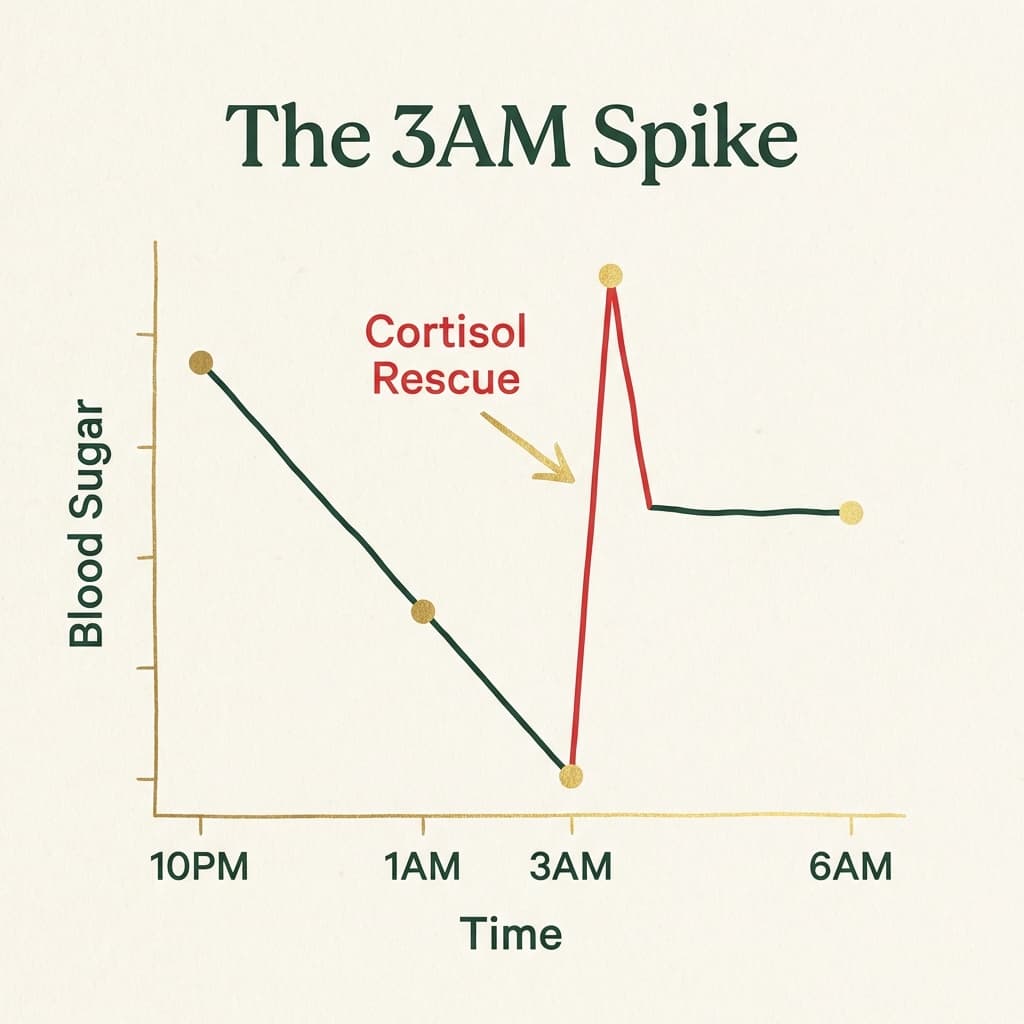
- Cortisol: To mobilize stored sugar.
- Adrenaline: To wake you up so you can find food.
That pounding heart? That racing mind? That is not "anxiety." That is an Adrenaline Shot administered by your own body to save you from a blood sugar crash.
Part 2: The Ancient Wisdom
Science explains the mechanism, but Ancient Wisdom explains the pattern.
In Traditional Chinese Medicine (TCM), the body follows a 24-hour "Organ Clock." Energy circulates through specific meridians at specific times.
- 11 PM – 1 AM: The Gallbladder Hour. (Associated with decision making/resentment).
- 1 AM – 3 AM: The Liver Hour.
The Live is the "General" of the body. It is responsible for detoxification—not just of toxins (like alcohol or caffeine), but of emotions. It processes anger, frustration, and stress.
If you are consistently waking up between 1:00 and 3:00 AM, TCM would say your "Liver Qi is Stagnant." The General is overwhelmed. He cannot process the load you gave him yesterday, so he wakes you up.
The Integration: Western Medicine says your liver is running out of glycogen (sugar). Eastern Medicine says your liver is blocked by stress. The solution for both is the same: Nourishment and Calm.
Part 3: The Protocol (The "Fix")
We cannot force your ovaries to produce 25-year-old levels of Progesterone. But we can stabilize the terrain so you can sleep through the night.
This is the "New Spring Deep Sleep Protocol."
Step 1: The Glucose Bridge (The Anchor)
We need to prevent that 3 AM blood sugar crash. To do this, we build a bridge of fat and protein to carry you through the night.
- The Action: 30 minutes before bed, eat 1 tablespoon of high-quality Almond Butter, a slice of hard cheese, or a teaspoon of MCT Oil.
- The Why: Fat burns slowly. It provides a steady drip-feed of energy to the brain, signaling "safety" to the adrenal glands. If the brain feels fed, it won't pull the Cortisol alarm. (We also recommend pairing this with proper supplementation. See our full guide on Magnesium for Deep Sleep).
Step 2: The Progesterone Mimic (The Support)
If we don't have Progesterone, we need to support the GABA receptors manually.
-
Supplement: Ashwagandha (KSM-66 Strain).
-
Dosage: 600mg with dinner.
-
The Science: Ashwagandha is an adaptogen that lowers serum cortisol. Studies show it can reduce the "awakening response" by up to 30%. It effectively tells the adrenal glands, "Stand down."
-
Hero Supplement: Myo-Inositol.
-
Dosage: 2g (2,000mg) in water before bed.
-
The Science: Inositol sensitizes your cells to insulin, helping stabilize that blood sugar drop. It is also shown to reduce panic and anxiety.
Step 3: The Liquid Thief (The Elimination)
I know you don't want to hear this. I know a glass of Pinot Noir feels like the only reward you get at the end of a hard day.
But Alcohol is the enemy of perimenopausal sleep.
- The Mechanism: Alcohol sedates you initially (GABA agonist), which helps you fall asleep. But as your liver metabolizes it (remember the Liver Hour?), it releases a stimulant byproduct called glutamate.
- The Result: This glutamate spike hits exactly 4 hours after your last drink—right around 3 AM. It guarantees a wake-up.
- The Swap: Tart Cherry Juice with Magnesium. Tart cherries naturally contain melatonin.
Summary
You are not fighting a battle against your thoughts. You are managing a transition of your biology.
- Validate: The wake-up is chemical, not psychological.
- Stabilize: Eat a fat-based snack before bed to stop the sugar crash.
- Support: Use Ashwagandha and Myo-Inositol to soothe the nervous system.
- Respect: Listen to the Liver Hour. If you wake up, put a hand on your heart and say, "I am safe. I am just remodeling."
Clinical References
- Friess, E., et al. (2008). Progesterone-induced sleep promotion is mediated by the GABA-A receptor. Journal of Endocrinology.
- Hirotsu, C., et al. (2015). Interactions between sleep, stress, and metabolism: From physiological to pathological conditions. Sleep Science.
- Moshfegh, A., et al. (2019). The effects of Inositol on anxiety and sleep quality: A randomized controlled trial. Journal of Clinical Psychopharmacology.