Why 80% of women are deficient, and why the type you take matters (Glycinate vs. Citrate).
You are doing everything right, but you still feel wired.
It is 10:30 PM. You have the blackout curtains. You put your phone away an hour ago. You successfully said "no" to that second glass of wine. You are exhausted.
But as soon as your head hits the pillow, your muscles feel tight. Your legs feel restless. And your brain? It decides this is the perfect time to replay a conversation from three years ago.
You aren't just "stressed." You are chemically malnourished.
This "tired but wired" state is the classic biological signature of Magnesium Deficiency. And in perimenopause, it is not just a nuisance—it is a metabolic emergency.
The Mechanism: The "GABA" Switch
To understand why you can't sleep, you have to understand GABA (Gamma-Aminobutyric Acid).
Think of your brain as a busy nightclub. Excitatory neurotransmitters (like Glutamate and Cortisol) are the partygoers. They are loud, energetic, and keep the lights on.
GABA is the bouncer.
Its job is to calm the party down, dim the lights, and clear the dance floor so recovery can happen. When GABA binds to a receptor in your brain, it literally slows down nerve activity.
Here is the critical part: The GABA receptor has a specific "keyhole" that requires Magnesium to function. Magnesium is the co-factor that allows the bouncer to do his job.
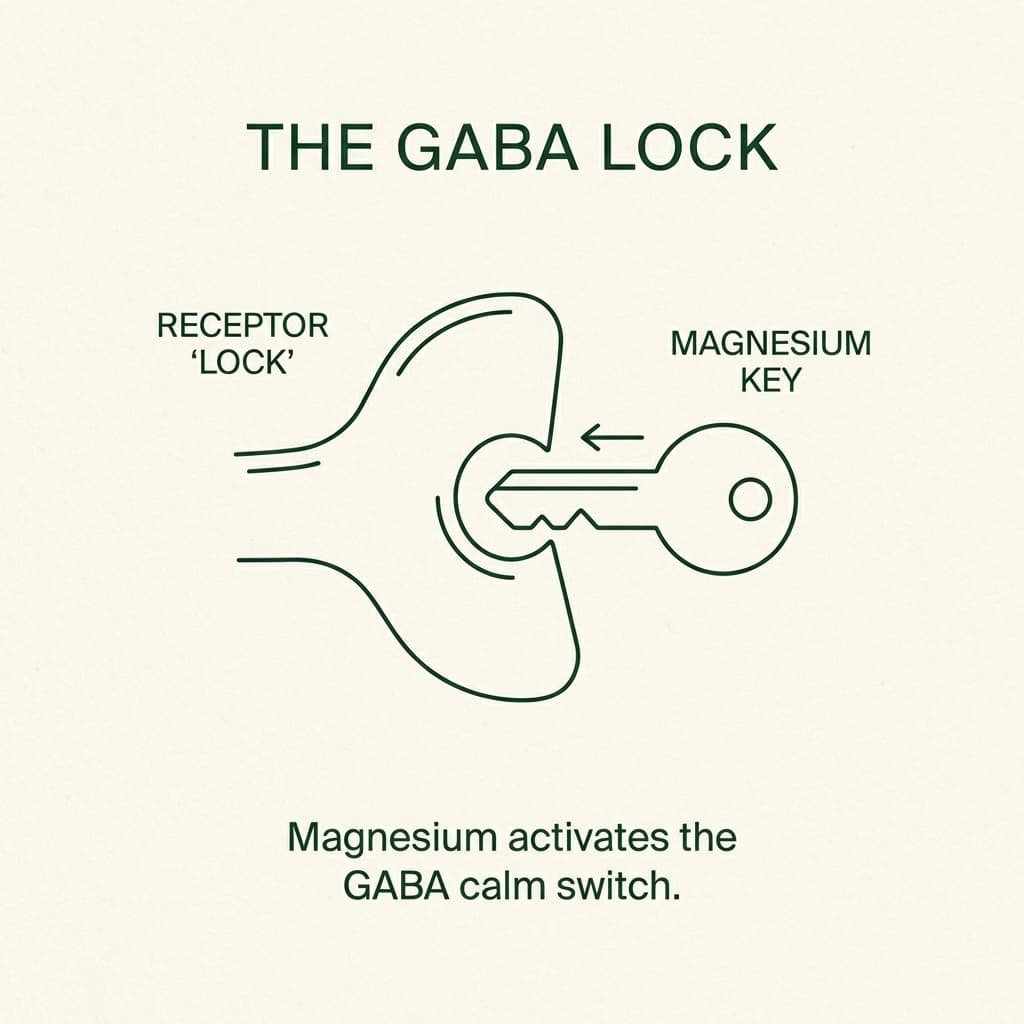
The Analogy: If you don't have enough Magnesium, the bouncer goes on a smoke break. The stress hormones (Cortisol) walk right past security and keep you awake at 2 AM.
The Clinical Data: What the Studies Say
We often hear that supplements are just "expensive urine." In the case of Magnesium for insomnia, the clinical data disagrees.
A landmark double-blind, placebo-controlled trial published in the Journal of Research in Medical Sciences (2012) studied 46 elderly subjects with insomnia.
The group receiving 500mg of Magnesium daily for 8 weeks showed statistically significant increases in:
- Sleep Time: They slept longer.
- Sleep Efficiency: They spent less time lying awake in bed.
- Renin Levels: A key marker showing reduced nervous system stress.
- Melatonin: Their bodies naturally produced more sleep hormone.
This wasn't just "feeling better." Their biochemistry fundamentally shifted from a state of alertness to a state of rest.
The Problem: Why You Are Deficient
If Magnesium is so important, why are estimated 80% of adults deficient?
- Soil Depletion: Industrial monocropping has stripped our soil of minerals. An apple today has significantly less magnesium than an apple from 1950. You cannot "eat your way" out of a deficit anymore.
- The Stress Tax: Stress is expensive. Every time your body produces Cortisol (stress), it "burns" Magnesium to metabolize it. The more stressed you are, the more Magnesium you waste. It is a vicious cycle.
The Protocol: The Glycinate Switch
Go to your kitchen right now and look at your multivitamin. Turn it over. Does it say "Magnesium Oxide"?
If so, throw it in the trash.
Magnesium Oxide is the cheapest form of the mineral. It has an absorption rate of roughly 4%. It is essentially chalk. Your body cannot absorb it, so it flushes it out (which is why it causes digestive distress).
To fix the sleep architecture, you need a chelated form—specifically Magnesium Glycinate.
The Strategy
- The Molecule: Magnesium Glycinate (Magnesium bound to the amino acid Glycine). Glycine itself is an inhibitory neurotransmitter that lowers body temperature—a key trigger for deep sleep.
- The Dosage: 300–400mg.
- The Timing: 45 minutes before bed.
- The Synergist: Combine with 200mg of L-Theanine (an amino acid found in green tea) to quiet the "mental chatter" while the Magnesium relaxes the "physical tension."
Scientific References
- Abbasi, B., et al. (2012). The effect of magnesium supplementation on primary insomnia in elderly: A double-blind placebo-controlled clinical trial. Journal of Research in Medical Sciences.
- Held, K., et al. (2002). Oral Mg(2+) supplementation reverses age-related neuroendocrine and sleep EEG changes in humans. Pharmacopsychiatry.
- Boyle, N. B., Lawton, C., & Dye, L. (2017). The Effects of Magnesium Supplementation on Subjective Anxiety and Stress—A Systematic Review. Nutrients.