Your body is literally stealing the building blocks of your sex hormones to make stress hormones. Here is how to stop the theft.
The Ultimate Hormone Theft
We treat perimenopause like it exists in a vacuum. We assume the fatigue, the brain fog, and the sudden weight gain are purely because our ovaries are retiring. But there is a hidden mechanism accelerating all of these symptoms, and it has nothing to do with your ovaries.
It has to do with your adrenal glands.
AUDIENCE: Women 35-55 This article is for the high-achieving woman who is doing everything "right" but still feels like her body is breaking down.
What is the Cortisol Steal?
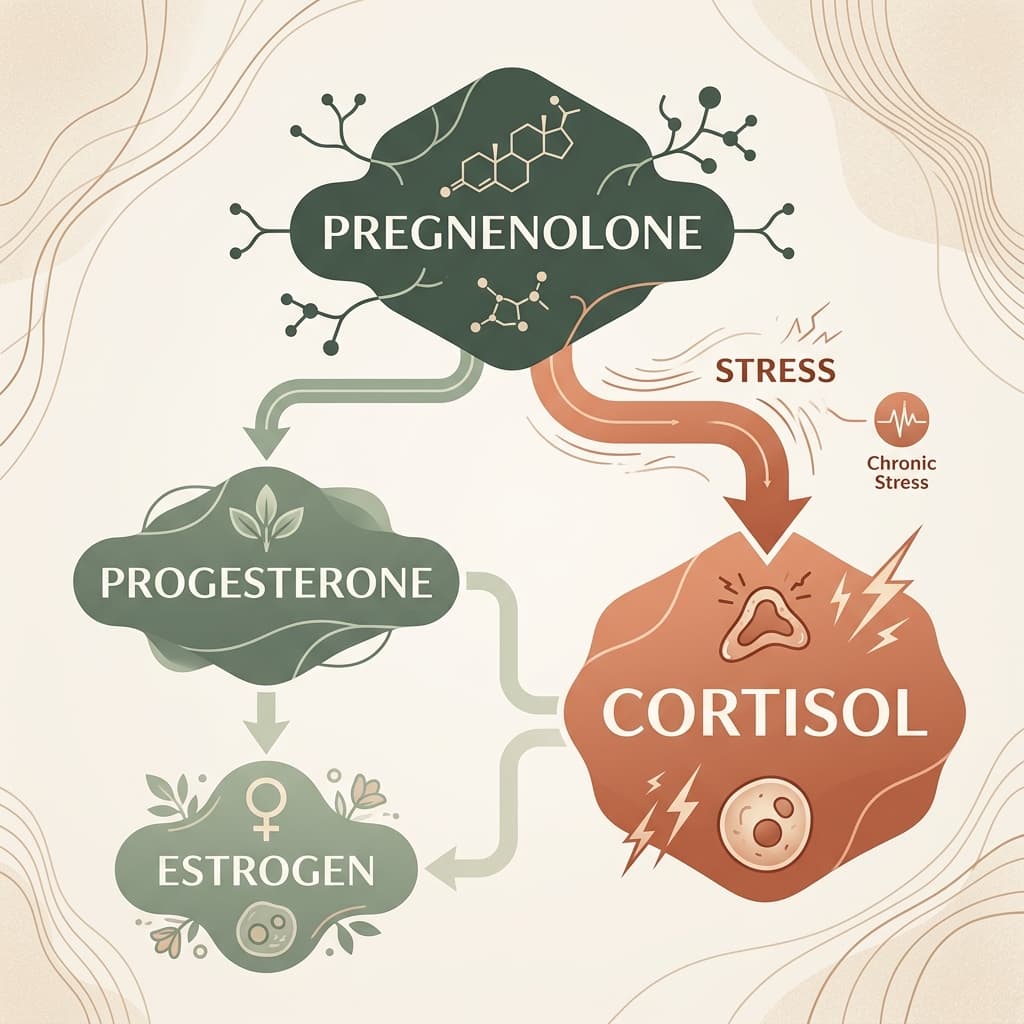
The "Pregnenolone Steal" (commonly referred to as the Cortisol Steal) is a biological triage mechanism.
All of your steroid hormones—including Estrogen, Progesterone, and Cortisol—are made from a single master precursor called Pregnenolone (which is synthesized from cholesterol).
When you are relaxed, Pregnenolone flows freely down the pathways to create adequate Progesterone and DHEA (which then becomes Estrogen and Testosterone).
But when you are under chronic stress—whether from a demanding job, poor sleep, or even over-exercising—your brain screams for Cortisol. Because survival always trumps reproduction, your body literally steals the Pregnenolone away from the sex hormone pathway and shunts it down the adrenal pathway to make Cortisol.
The Perimenopause Double-Whammy
In your 20s, a Cortisol Steal was manageable. Your ovaries were producing robust amounts of hormones to compensate.
But in perimenopause, your ovaries are winding down. Your body is increasingly relying on your adrenal glands and fat tissues to produce background levels of sex hormones. If your adrenals are completely hijacked by chronic stress, they cannot produce the necessary Progesterone and DHEA.
The result? The symptoms of perimenopause hit you like a freight train.
- Zero Progesterone: Progesterone is your calming, sleep-promoting hormone. When it gets stolen for cortisol, you experience raging anxiety and insomnia.
- Estrogen Dominance: Even though estrogen is dropping, progesterone drops faster because of the steal. This creates a relative "Estrogen Dominance," leading to heavy periods and breast tenderness.
- Visceral Fat Accumulation: High cortisol inherently drives the body to store fat around the midsection (the "menopause belly").
How to Stop the Theft
You cannot supplement your way out of the Cortisol Steal without addressing the root cause: the stress signal.
1. Radically Protect Your Sleep
Sleep is the only time your body clears the cortisol backlog. If you are sleeping less than 7 hours, your cortisol baseline is permanently elevated.
- The Action: Treat 10:00 PM to 6:00 AM as a non-negotiable biological mandate.
2. Ditch the Fasted HIIT
High-Intensity Interval Training (HIIT) on an empty stomach is fantastic for a 25-year-old male. For a 45-year-old woman in perimenopause, it is a massive cortisol spike.
- The Action: Switch to heavy, slow resistance training (to build bone and muscle) and Zone 2 cardio (walking, light cycling).
3. Carbohydrate Timing
Very low-carb diets (like strict Keto) can elevate cortisol over time because the brain perceives a lack of glucose as a starvation stressor.
- The Action: You don't need a high-carb diet, but strategically placing complex carbohydrates (like sweet potatoes or oats) in the evening can lower cortisol and promote serotonin and melatonin production, improving sleep.
The Takeaway
Your body is not betraying you. It is protecting you. It thinks you are being chased by a tiger, and it is prioritizing your survival over your fertility.
To get your hormones back, you have to convince your body that it is safe.
Research Facts
- Fact 1: Pregnenolone is the universal precursor to both the stress hormone cortisol and sex hormones like progesterone and DHEA. Under chronic stress, the HPA axis prioritizes the synthesis of cortisol over sex hormones.
- Fact 2: During the perimenopausal transition, ovarian output of sex hormones declines, making the body more reliant on adrenal synthesis of DHEA and progesterone. Chronic stress severely impairs this secondary source.
- Fact 3: Chronically elevated cortisol levels are directly correlated with an increase in visceral adiposity (belly fat) and a decrease in insulin sensitivity, exacerbating metabolic syndrome in midlife women.
Scientific References
- Ruiz-Mendez, et al. (2020). "The role of the HPA axis and the Pregnenolone Steal in menopausal symptomatology." Endocrine Reviews.
- Sapolsky, R. M. (2004). Why Zebras Don't Get Ulcers: The Acclaimed Guide to Stress, Stress-Related Diseases, and Coping.
- Epel, E. S., et al. (2000). "Stress and body shape: stress-induced cortisol secretion is consistently greater among women with central fat." Psychosomatic Medicine.
Sources & Citations
- [1]Ruiz-Mendez, et al. (2020). The role of the HPA axis and the Pregnenolone Steal in menopausal symptomatology.
- [2]Sapolsky, R. M. (2004). Why Zebras Don't Get Ulcers.
- [3]Epel, E. S., et al. (2000). Stress and body shape: stress-induced cortisol secretion is consistently greater among women with central fat.